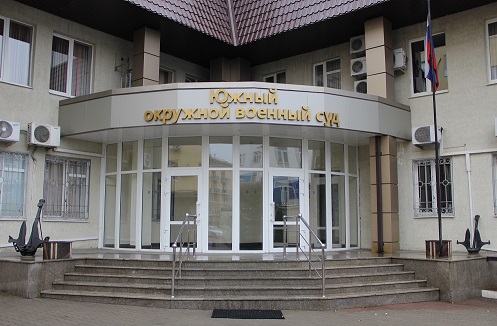
The Southern District Military Court has handed down a verdict against Alexander Belyaev, a resident of Sevastopol. According to the court’s press office, he was sentenced to five years’ imprisonment in a general-regime prison. It is noteworthy that the court’s website contains no information regarding the date and time of the sentencing hearing, which undermines its public nature – one of the fundamental guarantees of a fair trial.
According to the account provided by the court’s press office, the convicted man ‘between 10 August 2023 and 26 March 2024, whilst residing in Sevastopol, posted on a publicly accessible social media page which he administered text posts (posts) containing elements of persuasive discourse aimed at instilling in others the ideology of the banned terrorist organisation ‘Legion of Freedom of Russia’, as well as calls to join the LSR and the RDK in order to carry out their activities’.” No information regarding the content of the comments is publicly available, which precludes the possibility of verifying the objectivity of the linguistic expert’s conclusions.
Particular attention is drawn to the fact that the criminal case against a resident of occupied Sevastopol was not heard in a court in the occupied territory, as required by international humanitarian law, but in the Southern District Military Court, which is located in Rostov-on-Don, Russia. The participation of the Russian judge, Sakita Lachinov, in the proceedings calls into question the independence and impartiality of the court, as the case clearly concerns comments relating to hostilities in an armed conflict in which one party is the country of which the judge is a national, and the other is the country of which the defendant is a national.
Indirect evidence of the court’s bias is the length of time spent in the deliberation room, which, according to the case file and a statement from the court’s press office, amounted to less than six hours. Specifically, a court hearing was scheduled for 10.00 on 17 April, which concluded with the court retiring to the deliberation room to deliver its verdict. The date and time of the pronouncement of the verdict are not listed on the court’s website. Nevertheless, at 15:58, the court’s press office published information regarding the pronouncement of the verdict. It is clear that during this period (no more than five and a half hours), the court was expected to open the hearing, carry out all the formal procedures of the proceedings, conclude its consideration of the case, retire to the deliberation room to deliver its verdict, and only then return to announce it. It seems doubtful that, in such a short space of time, the court was able to make a full and objective assessment of all the circumstances of the case, the hearing of which had spanned twelve sessions.
It should be noted that, according to a study by the ‘Crimean Process’ on judicial practice in terrorism-related cases heard by the Southern District Military Court involving residents of occupied Crimea, as well as the Kherson and Zaporizhzhia regions, in 2025, the courts avoid publicity in terrorism-related cases and view such acts not through the prism of crimes threatening public safety, but as additional opportunities for the “justified” suppression of resistance, the demonstration of disloyalty and the legitimisation of coercive methods of control over the occupied regions.