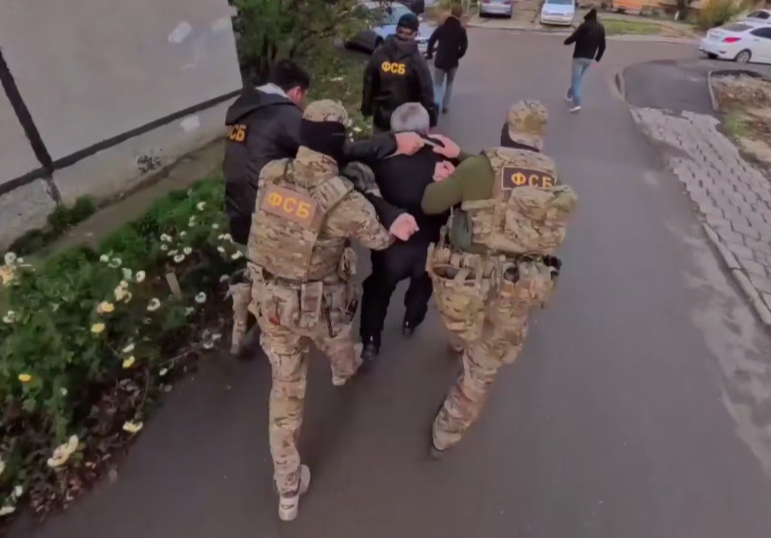
The Southern District Military Court has concluded its hearing of the criminal case against Sergei Obushny, a resident of Kerch, who was charged under the article on public calls to carry out terrorist activities, as well as under the article on public calls to carry out extremist activities. According to reports by Russian propagandists, the court sentenced the pensioner to six years in a penal colony for ‘calling for an attack on Red Square with drones during the 9 May parade’ in a Telegram chat. However, the reports do not mention the convicted man’s name; yet, based on his date of birth and a number of other identifying features, it is highly likely that the case concerns Sergei Obushny.
The case involved significant breaches of the principles of openness and transparency regarding the pronouncement of the sentence. On the official website, the date, time and place of the sentencing were only posted in the case file after the court had delivered its verdict. Consequently, members of the public were deprived of the opportunity to find out in advance where and when the sentence would be pronounced. No information regarding the sentence was provided on the court’s website, and it only became known to the media four days later, following its publication by the FSB’s press service.
Furthermore, the security services have not disclosed the details of the text message’s content, which contained linguistic and psychological indicators of justifying terrorist acts; this precludes the possibility of verifying to what extent the words written in the chat actually referred to ‘acknowledging the ideology and practice of terrorism as correct, deserving of support and emulation’. Nor is it possible to establish with certainty whether these statements were related to an analysis of causes or historical events. Furthermore, there is a complete lack of information regarding the specific charges brought against Obushny under the article on public calls for extremist activity.
Particular attention is drawn to the fact that the criminal case against a resident of occupied Kerch was not heard in a court on the occupied territory, as required by international humanitarian law, but in the Southern District Military Court, which is located in Rostov-on-Don, Russia. The participation of Russian judge Valery Opanasenko in the proceedings calls into question the independence and impartiality of the court, as the case concerns the public expression of an opinion on an armed conflict in which one party is the country of which the judge is a citizen, and the other is the country of which the defendant is a citizen.
Furthermore, it is worth noting that Russian media outlets did not report on the verdict immediately after it was handed down, but only after a statement had been issued by the press office of the FSB’s Crimean Regional Directorate. In most cases, the reports contained identical text and focused on the defendant’s past, noting that prior to his retirement he had been an officer of the Security Service of Ukraine (SBU) and had served in the Ukrainian Border Guard Service. No comments from Obushny himself or his lawyer were featured in any Russian media outlet.
Furthermore, the case serves as clear evidence of the argument that the Russian judicial system ignores the reality of an international armed conflict. Ukraine’s legitimate and natural right to self-defence against military aggression by the Russian army is interpreted by the court as terrorist activity directed against the Russian state. Such an interpretation contradicts international understandings of terrorism, as enshrined in the Shanghai Convention.
The practice of disregarding international armed conflict is described in detail in the joint study ‘Denial of the Right to a Fair Trial as an International Crime during Russia’s War against Ukraine: Context, Practice, Law and Prospects’, which provides well-reasoned evidence that such prosecutions are aimed at justifying military aggression against Ukraine. Furthermore, the study ‘Peculiarities of the prosecution of residents of occupied territories under terrorism-related articles’ established that, over a 10-month period last year, the Southern District Military Court heard at least 14 cases concerning the justification of terrorism against residents of Crimea. In not a single case were the texts of the statements provided for an independent analysis of their compliance with the criteria for justifying terrorism.