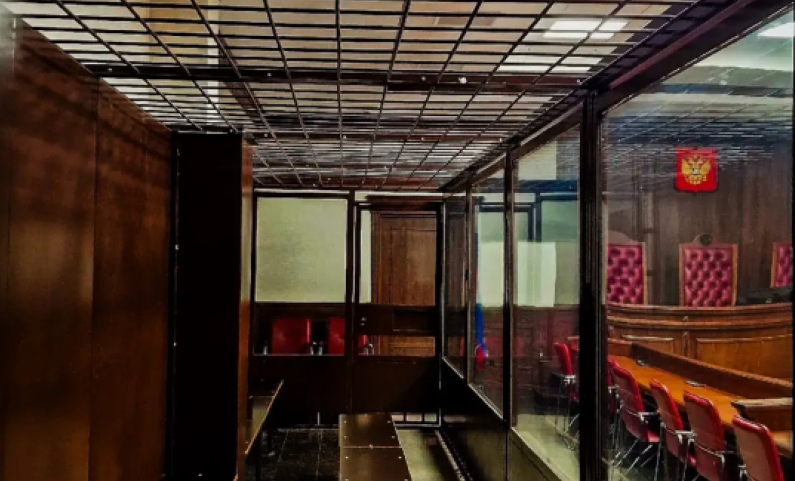
The Sevastopol City Court has concluded its hearing of a criminal case concerning aiding and abetting treason. The court’s official website states that the defendant was found guilty, but does not specify what sentence was imposed. This information is also absent from the websites of law enforcement agencies and propaganda outlets. The defendant’s personal details are also not publicly available. However, an analysis of the information provided suggests that the criminal proceedings were conducted with extremely serious breaches of standards of access to fair justice and appear to have been orchestrated with the verdict predetermined before the trial had even concluded.
The key irregularity apparent from the available information is that the criminal case was heard in just 2 minutes. This is evident from the case file on the court’s official website, which states that on 10 June the hearing was adjourned because the defendant failed to appear. On this basis, at the next hearing the court was required to carry out at least the following mandatory procedures: verify the defendant’s identity, announce the composition of the court, clarify the situation regarding challenges and motions, open and close the trial proceedings, hear the closing arguments of the parties (which could not have been a quick process, given that the defendant was represented by five lawyers), and retire to the deliberation room to deliver the verdict. However, according to the information provided, all these stages were omitted and the next hearing began immediately with the pronouncement of the verdict, which took two minutes. The trial was concluded at that point.
In this situation, particular attention should be drawn to the gross and irreparable breach by the court of the principles of the continuity of judicial proceedings and the confidentiality of the judges’ deliberations. Contrary to the procedure laid down by law, a mandatory stage of the proceedings—involving the delivery of the verdict in the deliberation room—was effectively omitted. This is evidenced by the judge’s participation in other court hearings in criminal cases on the day before the verdict was to be announced, including the delivery of appeal rulings. It was also noted that the final hearing prior to the pronouncement of the verdict in the case concerning aiding and abetting treason, in which the judge participated, began at 15:00 and was not adjourned on the grounds that the judge was in the deliberation room. In these circumstances, the court could not have set aside sufficient time to prepare its decision, which suggests that the verdict was prepared outside the court proceedings and without taking the defendant’s position into account.
In this regard, and taking into account other circumstances, there are serious doubts as to the independence and impartiality of the judge who heard the case. The verdict was handed down by the Russian judge Danil Zemlyukov, who had been transferred to the occupied territory from the Altai Krai. Under international humanitarian law, the administration of justice in an occupied territory is the responsibility of local judges, not representatives of the judicial system of the country that has occupied the territory. It should also be noted that Danil Zemlyukov regularly hands down convictions in cases of treason against residents of occupied Crimea. In particular, last October he reviewed the sentence imposed on Ksenia Svetlishina, and in January 2026 he handed down a sentence against Yevgeny Gudenkov, a Crimean resident who had previously been abducted.
Moreover, the judge has previously been observed to have heard similar cases in an unusually short space of time. In particular, the criminal case against Leonid Goretsky on charges of treason was heard in its entirety in no more than five hours. There is no doubt that hearing such complex cases involving particularly serious crimes in five hours cannot be considered comprehensive, thorough or objective.
Among other violations identified by representatives of the ‘Crimean Process’ during the prosecution of an unidentified individual, the concealment of the personal details of the defendant and the parties to the case was noted, including the details of no fewer than five of the defendant’s defence lawyers listed in the case file. Taken together, these measures had a significant negative impact on the transparency and public nature of the trial. This was particularly evident in relation to the pronouncement of the verdict, which, according to existing standards, is always carried out in public. This is further confirmed by the complete absence of any information regarding the verdict in the media controlled by the occupying authorities, as well as on the information resources of the security services.