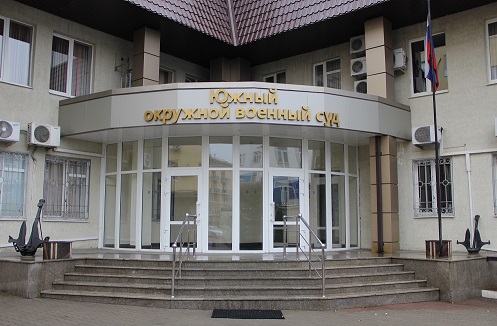
The Southern District Military Court handed down its verdict on eight Crimeans, finding six of them guilty of high treason, preparing a terrorist attack as part of a group, and participating in a terrorist organisation. Two women – Elena Voinarovskaya and Olga Kravchuk – were given suspended sentences under the article on the possession of explosive substances. According to the verdict, the court sentenced Viktor Podvalny, a resident of Yalta and the organiser of the group, to 27 years’ imprisonment (including 5 years in prison), a fine of 700,000 roubles and, following the completion of his sentence, 2 years’ restricted freedom. Kirill Barannik, a resident of Simferopol, received a sentence five years harsher than that sought by the prosecutor — 27 years’ imprisonment (including five years in prison), a fine of 600,000 roubles and, following the completion of his sentence, two years’ restricted liberty. Denis Petranov, a resident of Crimea, received a sentence one year harsher than that sought by the prosecutor – 23 years’ imprisonment (including 5 years in prison) and a fine of 600,000 roubles. The court handed down to Igor Zorin the sentence requested by the public prosecutor — 20 years’ imprisonment (including 4 years in prison), a fine of 500,000 roubles and, following the completion of his sentence, one and a half years’ restricted freedom. The court handed down sentences to Sergei Krivoshein and Sergei Voynarovsky that were one year shorter than the prosecutor had requested – both were sentenced to 19 years’ imprisonment (including 4 years in prison), fines of 500,000 roubles and, after serving their sentences, one and a half years of restricted freedom. The court handed down a five-year suspended sentence to Elena Voinarovskaya and a five-year and six-month suspended sentence to Olga Kravchuk.
On 3 May 2023, the FSB press office published a video showing the arrest of a ‘sabotage group of Ukrainian agents’. According to the prosecution, this group, acting on instructions from the Main Intelligence Directorate of Ukraine, was preparing a ‘series of high-profile acts of sabotage and terrorism’, the targets of which were the ‘head of the republic’ Sergey Aksyonov, the “Speaker of the Crimean Parliament”, Vladimir Konstantinov, the Mayor of Yalta, Yanina Pavlenko, as well as elements of the peninsula’s transport infrastructure; Kirill Barannik, who was not acquainted with the others, is accused of carrying out the bombings. Russian media, citing the FSB, report that six Russian and Ukrainian nationals, as well as a person holding dual Ukrainian and Bulgarian citizenship, have been detained in connection with the smuggling of explosives and components for explosive devices into Crimea. According to the FSB, five bombs, electric detonators, radio-controlled devices and tracking devices were found in their possession.
Most of the defendants did not admit guilt. According to the group’s ‘organiser’, Viktor Podvalny, he had never met or even heard of more than half of the group’s ‘members’ – Barannik, Krivoshein and Petranov – and had only met Zorin once in his life. He also insisted that the Voinarovskys and Olga Kravchuk were unaware that they were receiving a parcel containing explosives. Barannik pleaded guilty but denies involvement in an organised group. At the same time, he emphasised that he considers himself a citizen of Ukraine and regards Russian military aggression as a war of national defence for Ukraine.
During the trial It has emerged that the evidence against Elena Voinarovskaya was obtained under duress by FSB officers, who threatened to place her minor child in a care home in connection with her potential arrest. It is also widely reported that, following his abduction, Kirill Barannik gave evidence after being subjected to severe torture and threats that FSB officers would kill his mother. According to reports, which require further verification, Viktor Podvalny was also subjected to torture.
During the trial, a number of irregularities were noted, such as the partial withholding of information about the defendants and the parties to the case on the court’s official website, as well as indications of inequality between the parties. In particular, the court repeatedly dismissed motions by the defence to refer the case back to the prosecutor, to commission expert examinations, to have evidence declared inadmissible, and others. At the same time, the court permitted the prosecution to use the testimony of a confidential witness, as well as that of law enforcement officers, to present evidence. The defence also noted that at least one of the prosecution’s witnesses gave evidence in court using exactly the same words as those used in his statement during the pre-trial investigation, but was unable to provide any information beyond what was set out in the interrogation transcript.
Particular attention is drawn to the fact that the criminal case against residents of the occupied territory of Crimea was not heard in a court in the occupied territory, as required by international humanitarian law, and at the Southern District Military Court, which is located in Rostov-on-Don, Russia. The participation in the proceedings of a panel of Russian judges, including Judge Igor Kostin, calls into question the independence and impartiality of the court, as the case likely concerns actions related to an armed conflict in which one party is the country of which the judge is a citizen, and the other is the country of which the defendants are citizens. Furthermore, Judge Kostin has previously handed down sentences in similar cases, in which the defendants alleged torture and the fabrication of evidence in their criminal proceedings. In particular, in June 2026, this judge sentenced Vladimir Teterev, a farmer from the Zaporizhzhia region, to life imprisonment; Teterev had been abducted, tortured and had evidence fabricated against him in the case concerning the murder of the collaborator Vladimir Sushko. Also, in January 2025, Kostin handed down a sentence against Konstantin Gorpinchenko from Sevastopol, who was sentenced to 11 years’ imprisonment on charges of preparing a terrorist act.
Another indirect indication that the court was not independent when handing down the verdict is the length of time spent in the deliberation room after the conclusion of the trial proceedings and the closing arguments. The trial had been ongoing since May 2024 and comprised 49 court hearings involving eight defendants, who were collectively charged with 42 criminal offences. Nevertheless, the court deemed it sufficient to allocate less than a day to assess the substantial volume of evidence, which appears to be insufficient to ensure an objective and comprehensive assessment of the full scope of the established facts and the evidence presented.
The ‘terrorist’ nature of the charge provides further evidence to support the argument that the Russian judicial system is deliberately ignoring the fact that an international armed conflict is taking place. The court interprets the exercise by individual defendants of Ukraine’s legitimate and natural right to self-defence against military aggression by the Russian army as terrorist activity directed against the Russian state. Such an interpretation contradicts international understandings of terrorism, as enshrined in the Shanghai Convention.
The practice of disregarding the international armed conflict is described in detail in the joint study ‘Denial of the Right to a Fair Trial as an International Crime during Russia’s War against Ukraine: Context, Practice, Law and Prospects’, which provides well-reasoned evidence that such prosecutions are aimed at justifying military aggression against Ukraine. Furthermore, the study ‘Peculiarities of the prosecution of residents of occupied territories under terrorism-related articles’ established that, over a 10-month period last year, the Southern District Military Court heard at least 14 cases concerning the justification of terrorism against residents of Crimea. In not a single case were the texts of the statements provided for independent analysis of their compliance with the criteria for justifying terrorism.