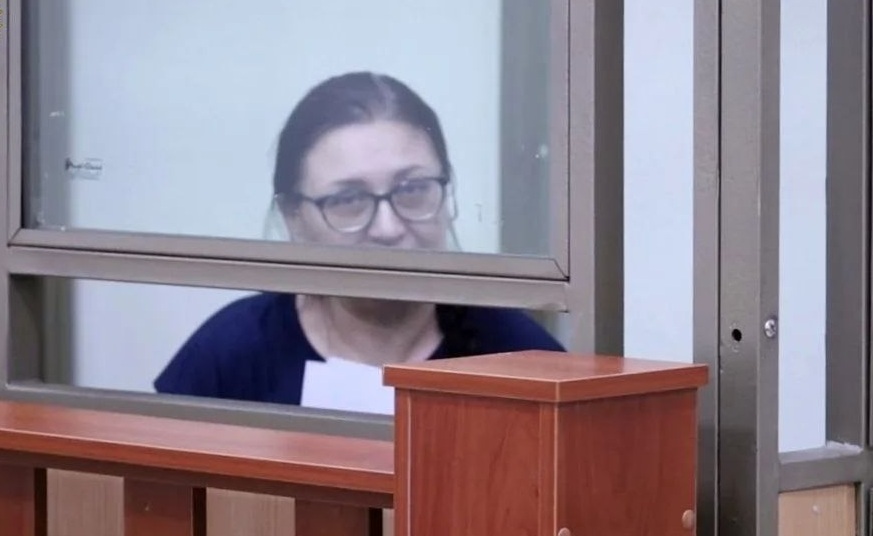
The Sevastopol City Court began and concluded the hearing of the criminal case against 45-year-old local resident Olga Tsirik, who was found guilty of treason in a single hearing. The judge imposed a sentence of 16 years’ imprisonment to be served in a general-regime penal colony, with one year’s restricted freedom following the completion of the main sentence, and a fine of 200,000 roubles.
According to the indictment, in 2023, whilst in Sevastopol, Tsirik allegedly, on her own initiative, established contact via an internet messaging service with a representative of the Ukrainian armed forces’ special services with the aim of engaging in confidential cooperation. On his instructions, she took photographs and gathered information on the locations of units, equipment and military facilities of the Russian Armed Forces, as well as naval vessels, and subsequently passed this information to the Main Intelligence Directorate of the Ministry of Defence of Ukraine for use against the security of the Russian Federation.
It was previously reported that Olga Tsirik had been held incommunicado for over a year in a special FSB prison based at Pre-trial Detention Centre No. 2 in Simferopol. Furthermore, following the formalisation of her arrest, screenshots of her WhatsApp correspondence were leaked to media outlets controlled by the Russian security services; amongst the negative comments was the phrase “maybe we should poison all this rabble?”. Even then, propagandists were portraying her as a criminal who had been plotting to poison participants in Russia’s military aggression.
Her trial was conducted with numerous violations of standards regarding access to a fair trial. In particular, whilst monitoring the proceedings, it was noted that the court took steps to conceal details about the defendant, as well as the date and venue of the sentencing hearing, which, according to the rules of criminal procedure, must always be held in public. At the time the information was released by the Press Office of the Public Prosecutor’s Office, the case file did not indicate that the pronouncement of the verdict was scheduled for that date, nor did it specify the time or the number of the courtroom. This constituted a significant obstacle to ensuring the openness of the proceedings, in particular the ability of members of the public to attend the pronouncement of the verdict.
It is also important to note that the trial was presided over by Igor Kozhevnikov — a Russian judge who was transferred from Smolensk following the occupation of Crimea and who is unlawfully administering justice in the occupied territory. The participation of the Russian judge Kozhevnikov in the trial calls into question the independence and impartiality of the court. Apart from the fact that the judge is a citizen of the country occupying the territory where the defendant resided, this is at least the fourth trial presided over by Judge Igor Kozhevnikov in cases involving a particularly serious offence (treason) to have taken place within an abnormally short period of time. According to the case file, the court scheduled the first hearing for 10 am, and just one hour and 45 minutes later, news of the verdict had already been published on the website of the Sevastopol City Prosecutor’s Office.
It seems doubtful that, in such a short period, the court was able to fully carry out all the necessary stages of the proceedings, which include establishing the defendant’s identity, announcing the composition of the court, explaining the defendant’s rights and the rules of procedure, clarifying matters relating to challenges and motions, opening and closing the trial, the opening and closing of the cross-examination phase, hearing closing statements, retiring to the deliberation room, delivering the verdict and pronouncing it. It seems unlikely that Judge Igor Kozhevnikov could have had the opportunity, in such a short space of time, to fulfil all the necessary requirements of the proceedings whilst, whilst in the deliberation room, managing to examine the case materials objectively and comprehensively—including the circumstances affecting the nature of the sentence—and then deliver a fair verdict. It should also be borne in mind that, during this same time frame, the representative of the public prosecutor’s office still had to pass this information on to the relevant department, where the text of the press release and three accompanying photographs were to be prepared and published.
Such a markedly formalised approach on the part of the judge, coupled with the synchronised coordination with the prosecution, may indicate a decision that had been planned and agreed upon even before the trial began. The trial itself, in this case, appears to be nothing more than a formal procedure, devoid of any possibility or intention to establish the truth.
The campaign to report on the verdict in the Russian media appears to be no less coordinated. At least six reports have been recorded across various media outlets, all of which cited the Crimean Public Prosecutor’s Office as their sole source of information. No comments from Olga Tsirik herself, her lawyer or members of the public present at the trial were featured in any Russian media outlet.