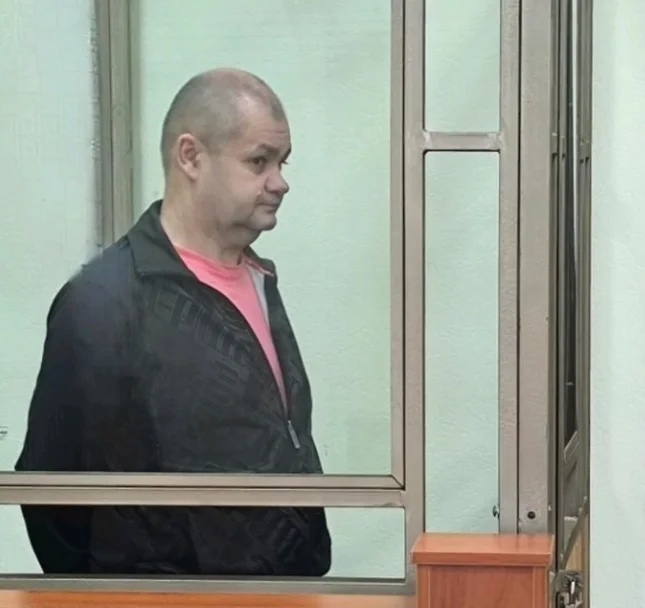
The Sevastopol City Court has concluded one of the longest trials in its history concerning cases of treason. The trial lasted 10 months, whereas such cases are typically heard within one to two months. The verdict was handed down to former Ukrainian soldier Ruslan Cherny-Shvets, who was found guilty of treason for allegedly systematically collecting and passing on information to the Ukrainian security services.
According to the prosecution, the man, who had previously served in the Ukrainian armed forces, was recruited by his former colleague Sergei Likhomanov, who, in turn, had been recruited by a staff officer of the SBU. In November 2023, they worked together to gather and pass on intelligence regarding units and facilities of the Russian army to their handler. In addition, Sergei Likhomanov was preparing to blow up a railway bridge across the Belbek River. Ruslan Cherny-Shvets was assisting him. Following his arrest, two briquettes of hexogen-based explosive weighing over 1 kg, a radio-controlled detonator and an electric detonator were found at his home.
Taking into account the sentence previously imposed under the article concerning the unlawful acquisition and possession of explosives, the Sevastopol City Court sentenced him to 18 years’ imprisonment in a maximum-security prison and a fine of 330,000 roubles. According to the court’s press office, the criminal case was heard in a closed hearing due to the presence of information constituting a state secret in the case file.
However, whilst monitoring the proceedings, it was noted that the court had taken steps to conceal details regarding the defendant, as well as the date and venue of the sentencing, which, in accordance with the rules of criminal procedure, must always be announced in public. At the time the information was released by the court’s press office, the case file did not indicate that the pronouncement of the verdict was scheduled for that date, nor did it specify the time or the number of the courtroom. This constitutes a significant obstacle to ensuring the transparency of judicial proceedings.
It is also noteworthy that the press office of the Sevastopol Public Prosecutor’s Office was not only notified of the date of the sentencing hearing but also granted permission to photograph the defendant. This further indicates preferential treatment for representatives of law enforcement agencies and unequal conditions in ensuring the transparency of judicial proceedings.
Furthermore, it is worth noting the unusually short time the judge spent in the deliberation room before delivering the verdict. According to information on the court’s official website, the court was due to open the hearing at 10 am and, at the very least, announce that the judge was retiring to the deliberation room. Given that the first report of the verdict in the Russian media was recorded at 12.32 pm, the judge spent less than two hours on an objective assessment of the evidence. This appears to be an insufficient amount of time for this type of case and may indicate that the verdict had already been decided before the judge retired to the deliberation room.
In this regard, and taking into account other circumstances, the independence and impartiality of the judge who heard the case are called into serious doubt. Igor Kozhevnikov is a Russian judge who is unlawfully administering justice in the occupied territory in the interests of the occupying power. Furthermore, it is precisely in Kozhevnikov’s rulings on cases of high treason that ‘The Crimean Process’ has repeatedly noted abnormally short timeframes for the consideration of cases. On at least three occasions, this judge concluded court proceedings within a matter of hours.
Particular attention should be paid to the information campaign in Crimean and major Russian media, which showed signs of presenting the verdict in a one-sided manner from the prosecution’s perspective. At least 15 publications with identical content have been recorded on major federal media outlets, all of which present the position of the prosecution or the FSB. These included instances of linguistic manipulation and stigmatisation, such as referring to the former serviceman as an ‘ex-militant’ or to one side in the conflict as the ‘Kyiv regime’. Furthermore, many articles claimed that the defendant was an ‘SBU agent’, even though the court’s verdict had not yet come into force. The position of the defence and the defendant is not presented in the publications. There is also no mention of any attempts to obtain such information.