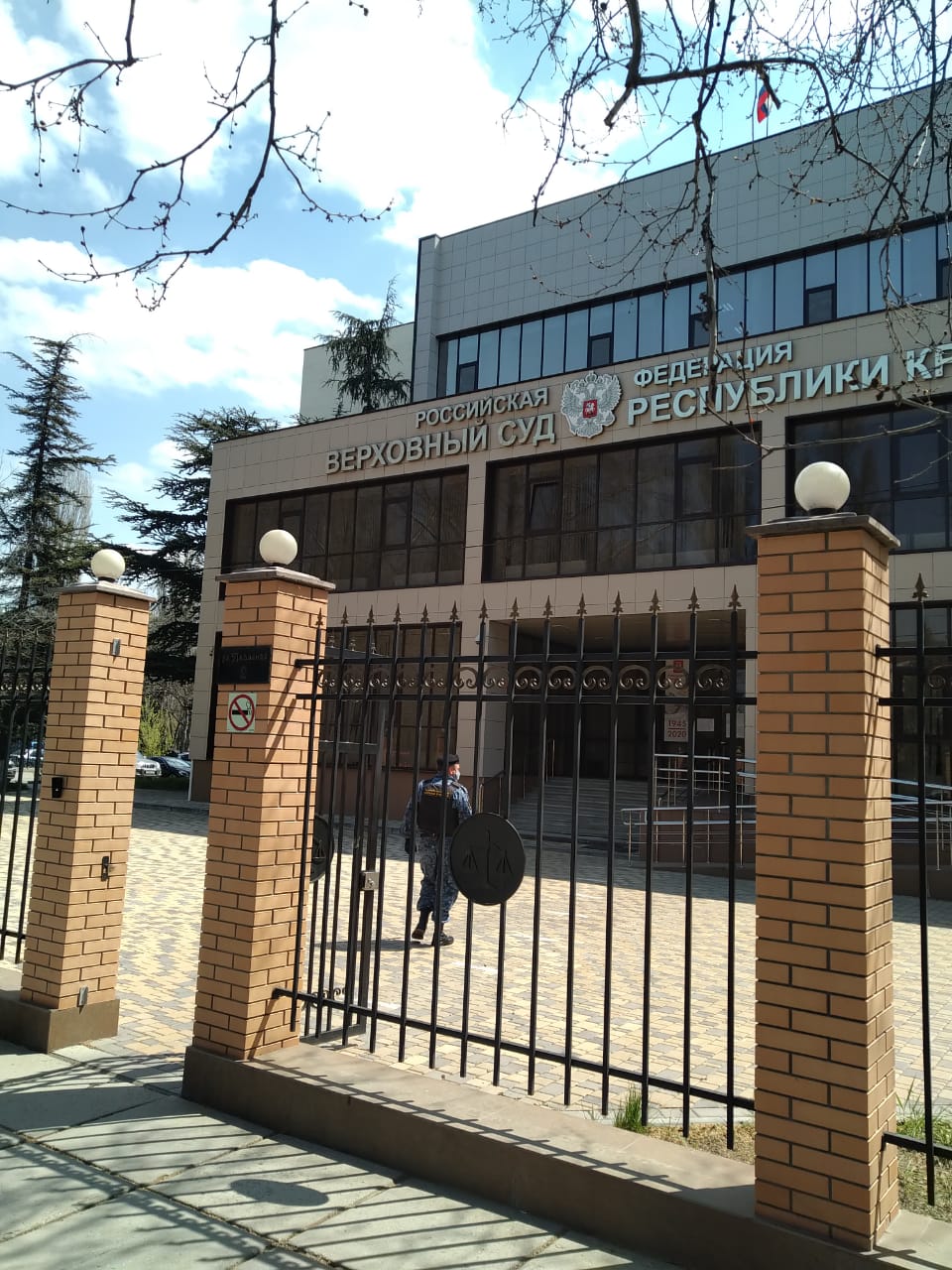
The Supreme Court of the Republic of Crimea has concluded its hearing of the criminal case against a Kerch resident born in 1965, who was found guilty of high treason. According to reports by Russian propagandists citing the court’s press office, he was sentenced to 18 years in a strict-regime penal colony, a fine of 400,000 roubles and a restriction of liberty for one year and six months following the serving of his main sentence.
The indictment alleged that the defendant, “being opposed to the special military operation, filmed a patrol vessel in the summer of 2023 and sent the video file to an acquaintance to be forwarded to a representative of the Ukrainian security services.” The personal details of the convicted man from Kerch have been redacted on the court’s official website; however, one of the public groups linked to the Russian security services claims that the individual in question is Igor Georgievich Boiko, born in 1965.
All six court hearings and the pronouncement of the verdict took place behind closed doors. This had a significant negative impact on the transparency and openness of the trial.
Furthermore, there are well-founded doubts regarding the independence and impartiality of the presiding judge, as the verdict was handed down by Judge Natalya Kulinskaya, against whom two criminal cases have been brought by the Ukrainian law enforcement authorities and who demonstrated clear dependence on the FSB during the trial of the human rights defender and journalist Irina Danilovich. Over the past year, Judge Kulinskaya has already handed down convictions for high treason against the abducted Crimeans Ismail Shemshedinov and Oleksandr Osadchy. For these reasons, the court’s impartiality towards individuals accused of working for the Ukrainian security services raises serious doubts.
An equally important aspect of the persecution is the information campaign in the Crimean and major Russian media. It is worth noting the high degree of synchronisation between the court proceedings and the dissemination of information — formally, the pronouncement of the verdict was concluded at 14:15, and by 14:48 the prepared article had already been published on one of the major Russian media outlets. Overall, the campaign showed signs of a one-sided presentation of the verdict from the perspective of the investigation and the prosecution. At least ten articles were identified in major federal media outlets, the content of which reflected only the prosecution’s position, whilst the defence’s and the defendant’s positions were not represented in such articles. Furthermore, some media outlets included manipulative statements in their texts and headlines, for example, by claiming that the defendant had passed information directly to the Ukrainian security services, although this fact had not been established by the court.
In addition to the above, it is worth noting the phrasing ‘as an opponent of the special military operation’, which may serve as an indicator of persecution for one’s political stance rather than for actual acts, the veracity of which raises insurmountable doubts. A joint study entitled ‘Denial of the Right to a Fair Trial as an International Crime during Russia’s War against Ukraine: Context, Practice, Law and Prospects’ describes in detail how the Russian judicial system ignores the fact of an international armed conflict and Ukraine’s legitimate right to self-defence against military aggression by the Russian army.