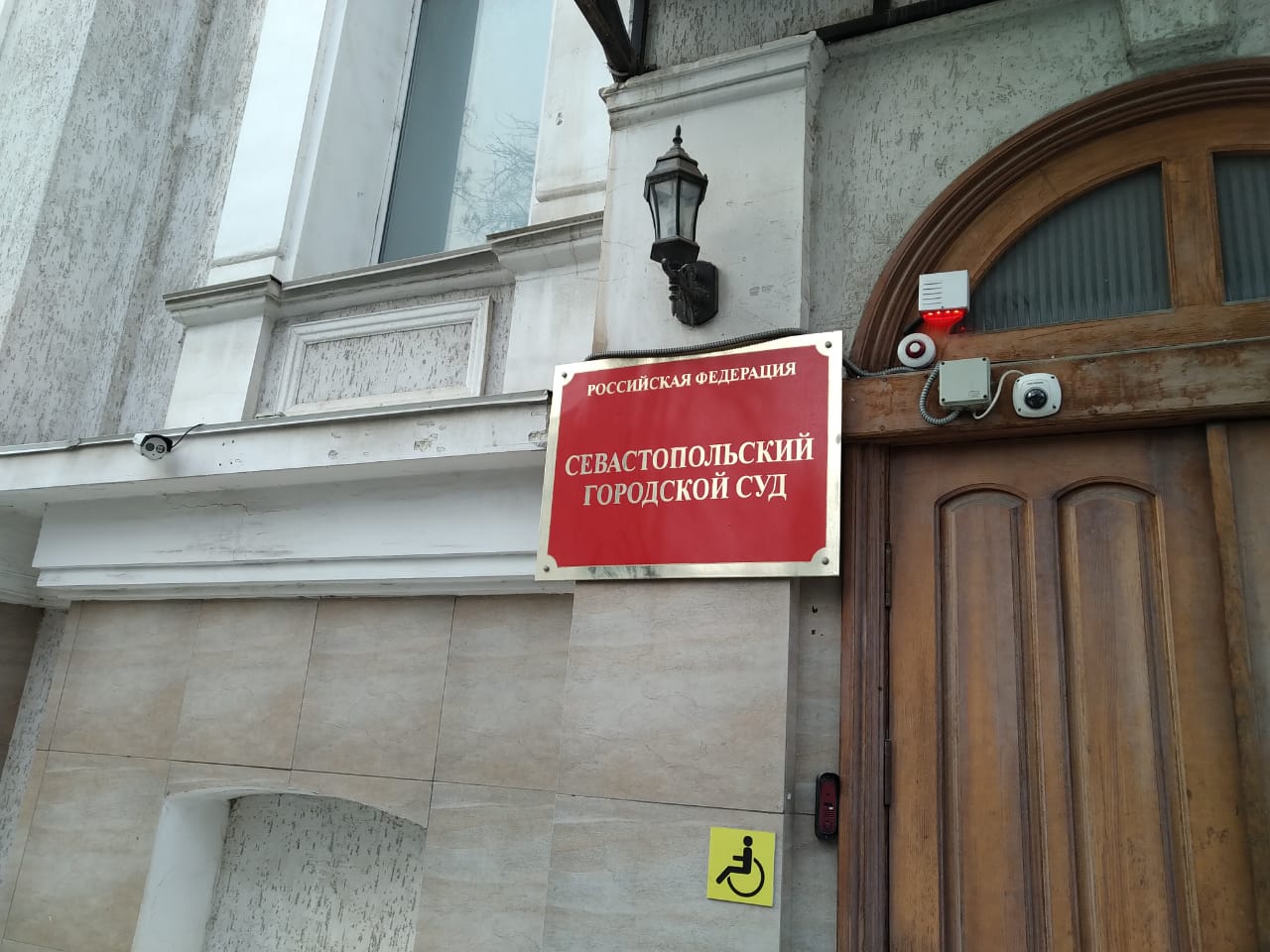
The Sevastopol City Court has concluded its hearing of the criminal case against 55-year-old Sevastopol resident Vladimir Zosich, who was found guilty of treason and the unlawful possession of an explosive device. According to a statement from the Russian Prosecutor’s Office in Sevastopol, he was sentenced to 17 years in a strict-regime penal colony and a fine of 250,000 roubles, as well as one year of restricted freedom following the completion of his main sentence.
According to the report, the convicted Crimean man “was recruited in February 2025 by an SBU officer and agreed to assist a foreign state in activities directed against the security of the Russian Federation. On the instructions of a representative of the Ukrainian security service, the man retrieved a mobile phone from a hiding place in Sevastopol to conduct covert correspondence. Following this, Zosich was tasked with carrying out visual reconnaissance of the location of a military facility.”
The personal details of the defendant and the parties to the case have been redacted on the court’s official website. The entire trial and the pronouncement of the sentence took place behind closed doors. This is also reflected in the case file on the court’s official website. Taken together, these measures had a significant negative impact on the transparency and public nature of the trial. This was particularly true of the pronouncement of the sentence, which, according to existing standards, is always carried out in public.
It is also noted that the court committed a gross and irreparable breach of the principles of the continuity of judicial proceedings and the confidentiality of judges’ deliberations. Following the adjournment announced at the hearing on 2 July, the court was obliged to resume proceedings, complete the judicial proceedings (including closing arguments and the defendant’s final statement, if these had not been concluded), retire to the deliberation room to deliver the verdict, and publicly announce the time of its pronouncement. Contrary to the procedure laid down by law, the following court hearing began immediately with the reading out of the final decision, which indicates that the mandatory stages of the proceedings were in fact omitted.
Furthermore, the claim that the judge was in the deliberation room is completely refuted by objective evidence of his activities. The day before the verdict was announced, the judge presided over other proceedings; in particular, he considered two appeals and issued rulings on them. This circumstance rules out the physical possibility of maintaining the confidentiality of the deliberations and confirms that the verdict in this case was formulated outside the framework of the judicial procedure established by law.
In this regard, and taking into account other circumstances, the independence and impartiality of the judge who heard the case are called into serious question. Igor Kozhevnikov is a Russian judge who is unlawfully administering justice in the occupied territory in the interests of the occupying power. Moreover, it is precisely in Kozhevnikov’s rulings on cases of high treason that ‘The Crimean Process’ has repeatedly noted abnormally short timeframes for the consideration of cases. On at least three occasions, this judge concluded court proceedings within a matter of hours.
The information campaign in Crimean and major Russian media deserves special attention, as it showed signs of presenting the verdict in a one-sided manner from the prosecution’s perspective. At least 10 publications with identical content have been recorded in major federal media outlets, all of which present the prosecution’s position. Many of these articles claim that the defendant is an ‘SBU agent’, even though the court’s verdict has not yet come into force. The position of the defence and the defendant is absent from these articles. There is also no mention of any attempts to obtain such information.