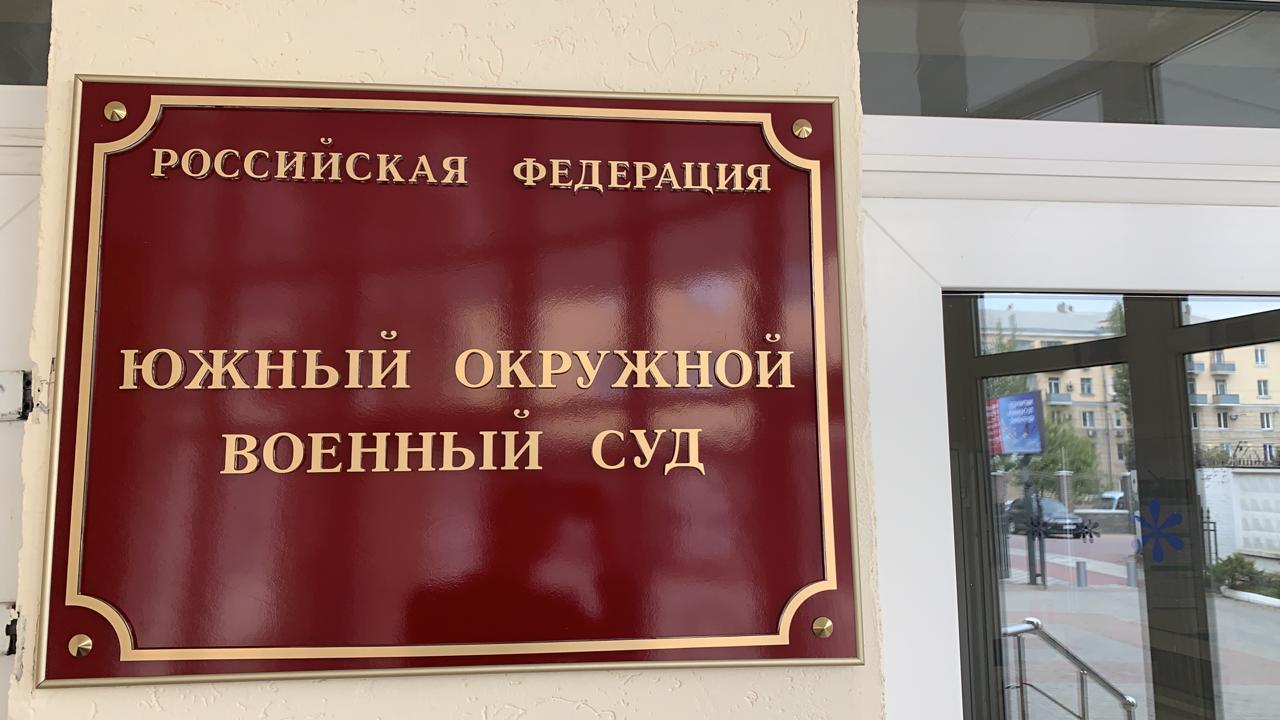
The Southern District Military Court handed down a verdict against Sergei Moskalenko, a resident of Berdyansk, who was accused of plotting a sabotage operation against a member of the ‘United Russia’ party. The court found him guilty under articles relating to high treason, the unlawful manufacture and trafficking of explosives or explosive devices, attempted terrorist acts, participation in a terrorist organisation, and undergoing training for the purpose of carrying out terrorist activities. According to the sentence handed down, he has been sentenced to 25 years’ imprisonment, with the first five years to be served in prison and the remainder in a strict-regime penal colony, and ordered to pay a fine of 800,000 roubles.
According to the account provided by the military court’s press office, ‘in September 2022, whilst in Berdiansk, Zaporizhzhia Oblast, the defendant, at the request of an acquaintance, retrieved explosives and explosive devices from a hiding place and took them to his own flat, where he kept them until 22 July 2024.
At the end of 2023, during a telephone conversation, Moskalenko was asked to assist Ukraine, to which he agreed. During the same period, an officer from the Main Intelligence Directorate of the Ukrainian Ministry of Defence contacted the defendant and offered him confidential cooperation, to which Moskalenko… agreed. On 1 July 2024, the defendant was tasked with killing a member of the ‘United Russia’ party by detonating an improvised explosive device (IED); subsequently, from 2 to 22 July 2024, he carried out surveillance of her place of residence, established her work schedule and travel routes, and identified the most suitable location and time for planting the IED, however, he did not carry out the crime to its conclusion, as Moskalenko was arrested on 22 July 2024.” No news reports could be found regarding the arrest in Berdyansk in July 2024 of an individual who was planning an assassination attempt on a member of a Russian party.
Particular attention is drawn to the fact that the criminal case against a resident of occupied Berdyansk was not heard in a court in the occupied territory, as required by international humanitarian law, but in the Southern District Military Court, which is located in Rostov-on-Don, Russia. The participation of the Russian judge Denis Vovchenko in the proceedings calls into question the independence and impartiality of the court, as the case concerns hostilities in an armed conflict in which one party is the country of which the judge is a national, and the other is the country of which the defendant is a national.
Indirect evidence of the court’s bias is the length of time spent in the deliberation room, which, according to the case file, amounted to no more than 2 minutes. Specifically, a court hearing was scheduled for 9.30 am on 5 August, and at 9.53 am it was noted that the proceedings had moved to the sentencing stage, which requires the judge to be in the deliberation room. Two minutes later, the proceedings moved to the sentencing stage. Even if one were to assume that a technical error occurred on the website, resulting in an inaccurate time being recorded, by 11.20 (eighty-seven minutes after the judge retired to the deliberation room), the court’s press office had already published a prepared press release regarding the sentence handed down. It seems doubtful that, in such a short period, the court was able to make a full and objective assessment of all the circumstances surrounding the seven criminal counts and to weigh up the entirety of the evidence, the presentation of which had required 15 court hearings.
Furthermore, the case serves as clear evidence of the assertion that the Russian judicial system ignores the fact of an international armed conflict. Ukraine’s lawful and natural right to self-defence against military aggression by the Russian army is interpreted by the court as terrorist activity directed against the Russian state. Such an interpretation contradicts international understandings of terrorism, as enshrined in the Shanghai Convention.
The practice of disregarding international armed conflict is described in detail in the joint study ‘Denial of the Right to a Fair Trial as an International Crime during Russia’s War against Ukraine: Context, Practice, Law and Prospects’, which provides a well-reasoned argument that such prosecutions are aimed at justifying military aggression against Ukraine.