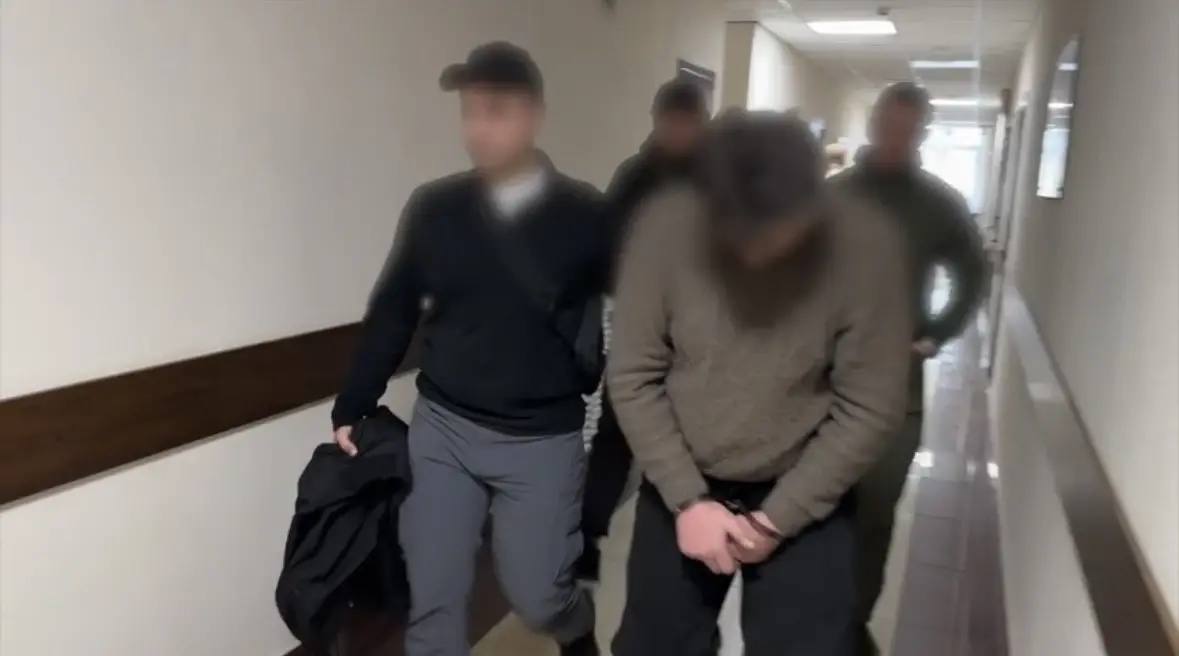
The Supreme Court of the Republic of Crimea has concluded its consideration of the criminal case against an unidentified resident of Feodosia, who was found guilty of high treason. According to a statement from the Russian Prosecutor’s Office in Crimea, he was sentenced to 16 years’ imprisonment in a strict-regime prison and a further 1 year and 6 months’ restriction of liberty following the completion of his main sentence.
According to the report, the Feodosia resident, “being opposed to the special military operation, took the initiative in September 2024 to gather information on the movements of a reconnaissance and strike helicopter, and also photographed it. The man sent all the information he had gathered via a messaging app to a chatbot used by the Ukrainian security service,” the prosecution’s press office reported.
The convicted man’s personal details are concealed on the court’s official website. All five court hearings and the sentencing hearing were held in camera. However, at the time of publication, there was no information to indicate that the sentencing hearing had taken place. The text of the court’s decision is also missing. Furthermore, it has been noted that details of one of the hearings only appeared on the court’s website three days after it had taken place. Taken together, this had a significant negative impact on the transparency and public nature of the trial. This was particularly true of the sentencing, which, according to existing standards, is always conducted in public.
Furthermore, the independence and impartiality of the presiding judge in the trial raise legitimate doubts, as the verdict was handed down by Judge Alla Khinevich, who was sentenced by a Ukrainian court to 14 years’ imprisonment for treason. For this reason, there are serious doubts as to the court’s impartiality towards individuals accused of working for the Ukrainian security services. It is important to note that Khinevich is the most actively involved judge in the Supreme Court of Crimea in terms of the number of cases heard on charges of high treason: 11 verdicts under this article last year alone, and already five since the start of 2026. Previously, Alla Khinevich also played a prominent role in the politically motivated prosecution of the Crimean Tatar politician Lenur Islyamov, whose trial demonstrated a breach of the principle of equality of arms, as the defence was restricted to presenting evidence over the course of just two hearings.
An equally important aspect of the persecution is the information campaign in the Crimean and major Russian media. There was a high degree of coordination between the court, the prosecution and the dissemination of information – formally, the sentencing was scheduled for 10:00, yet by 10:17 a prepared article with a photograph had already been published on the websites of the so-called Prosecutor’s Office of the Republic of Crimea. Overall, the campaign showed signs of a one-sided presentation of the verdict from the prosecution’s perspective. At least five articles were identified on major federal news sites, the content of which reflected only the prosecution’s position, whilst the defence’s and the defendant’s positions were not represented in these articles.
Particular note should be made of the phrase ‘as opponents of the special military operation’, which may serve as an indicator of persecution for one’s political stance rather than for actual acts, the veracity of which raises insurmountable doubts. A joint study entitled ‘Denial of the Right to a Fair Trial as an International Crime during Russia’s War against Ukraine: Context, Practice, Law and Prospects’ describes in detail how the Russian judicial system ignores the fact of an international armed conflict and Ukraine’s legitimate right to self-defence against military aggression by the Russian army.