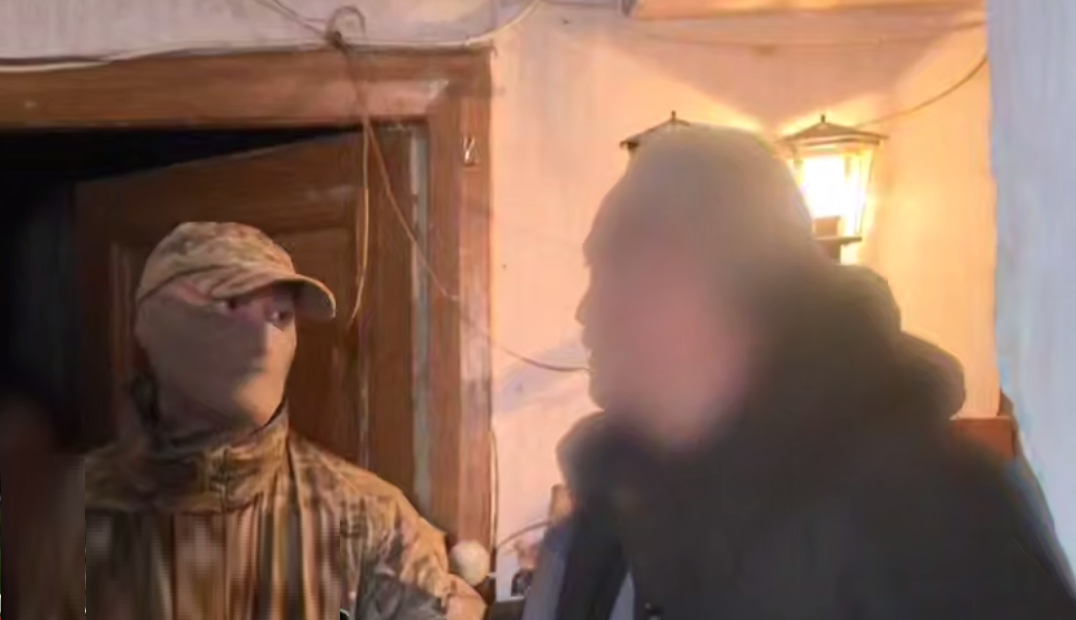
The Southern District Military Court handed down a verdict against a resident of Alupka, whose arrest had been announced by the FSB on 23 March 2026. According to the press office of the Crimean branch of the FSB, the court sentenced him to a fine of three hundred thousand roubles and banned him from administering websites, forums, chat rooms and groups for a period of one year and eight months. The security services have not disclosed the defendant’s details; however, based on the court hearing schedule, the list of individuals in the register of extremists and terrorists, and information regarding his year of birth, it can be stated with a high degree of certainty that the individual in question is Andrei Blokhin, born in 1971.
According to the version presented by the security agency’s press office, the convicted man “posted comments on his personal Telegram page supporting the sabotage and terrorist activities of members of a terrorist community. A linguistic analysis confirmed the presence of signs justifying terrorism in the published material”. No information is publicly available regarding the content of the comment or the specific terrorist group to which it referred, which makes it impossible to verify the objectivity of the linguistic analysis’s conclusions.
Particular attention is drawn to the fact that the criminal case against a resident of occupied Alupka was not heard in a court in the occupied territory, as required by international humanitarian law, but at the Southern District Military Court, which is located in Rostov-on-Don, Russia. The participation of Russian judge Denis Stepanov in the proceedings calls into question the independence and impartiality of the court, as the case may concern comments relating to hostilities in an armed conflict in which one party is the country of which the judge is a national, and the other is the country of which the defendant is a national.
Indirect evidence of the court’s bias is the length of time spent in the deliberation room, which, according to the case file, amounted to less than two and a half hours. Specifically, a court hearing was scheduled for 14:00 on 6 August, and at 16:30 it was noted that the proceedings had moved to the sentencing stage. It is clear that during this period the court was supposed to open the hearing, carry out all the formal procedures of the proceedings, conclude its consideration of the case, retire to the deliberation room to reach a verdict, and only then return to announce it. It seems doubtful that, in such a short period, the court was able to make a full and objective assessment of all the circumstances, even under the special procedure for the trial.
What is striking is the coordinated campaign to report on the verdict in the Russian media. At least five articles have been identified across various media outlets, all of which cited the FSB press office as their sole source of information, and only on the day following the actual pronouncement of the verdict. No comments from Blokhin himself or his lawyer, Maksim Zheglov, regarding the trial or the verdict were featured in any Russian media outlet.
It should be noted that, according to a study by ‘The Crimean Process’ on judicial practice in terrorism-related cases heard by the Southern Military District Court involving residents of occupied Crimea, as well as the Kherson and Zaporizhzhia regions, in 2025, the courts avoid publicity in terrorism-related cases and view the acts not through the prism of crimes threatening public safety, but as additional opportunities for the ‘justified’ suppression of resistance, the demonstration of disloyalty and the legitimisation of forceful methods of control over the occupied regions.
* The photograph shows a still image taken at the moment of Andrei Blokhin’s arrest in the spring of 2026