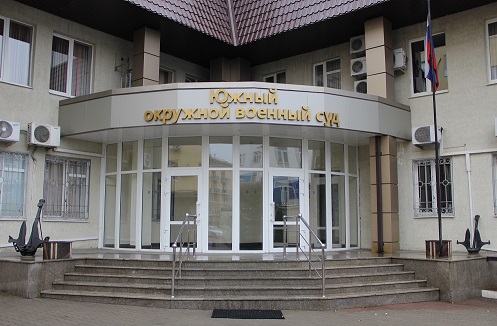
On 20 August, the Southern District Military Court handed down a verdict against an unidentified Crimean woman, who was found guilty under articles relating to treason, the unlawful manufacture and trafficking of explosives or explosive devices, and the attempted commission of a terrorist act. According to reports from propaganda outlets citing the FSB’s Public Relations Centre, she was sentenced to 15 years’ imprisonment, followed by one year of restricted freedom.
According to Russian security services, the woman, acting on instructions from the Ukrainian secret services, was planning to set fire to a signal box on the railway in Crimea in order to disrupt military transport. During a search of her home, homemade incendiary devices, materials for their manufacture and mobile phones were allegedly found. It has been established that her actions were “coordinated from Ukraine via the Viber messaging app, as confirmed by data from the seized devices”.
Particular attention is drawn to the fact that the criminal case against a resident of occupied Crimea was not heard in a court in the occupied territory, as required by international humanitarian law, but at the Southern District Military Court, which is located in Rostov-on-Don, Russia. The participation of the Russian judge Denis Vovchenko in the proceedings calls into question the independence and impartiality of the court, as the case concerns hostilities in an armed conflict in which one party is the country of which the judge is a national, and the other is the country of which the defendant is a national.
Indirect evidence of the court’s bias is the length of time spent in the deliberation room, which, according to the case file, amounted to less than a minute. Specifically, on 20 August at 11.24, the court retired to the deliberation room. At the same time, at 11.24, the court proceeded to the sentencing stage. It seems doubtful that, in such a short period, the court was able to make a full and objective assessment of all the circumstances relating to the five criminal counts and to weigh up the entirety of the evidence, the presentation of which had required three court hearings. Previously, this same judge had already handed down a verdict against a resident of the occupied territory after spending just two minutes in the deliberation room.
Furthermore, the case serves as clear evidence of the argument that the Russian judicial system ignores the fact of an international armed conflict. Ukraine’s lawful and natural right to self-defence against military aggression by the Russian army, including in the occupied territory, is interpreted by the court as terrorist activity against the Russian state. Such an interpretation contradicts international concepts of terrorism as enshrined in the Shanghai Convention.
The practice of disregarding the international armed conflict is described in detail in the joint study ‘Denial of the Right to a Fair Trial as an International Crime during Russia’s War against Ukraine: Context, Practice, Law and Prospects’, which provides well-reasoned evidence that such prosecutions are aimed at justifying military aggression against Ukraine.