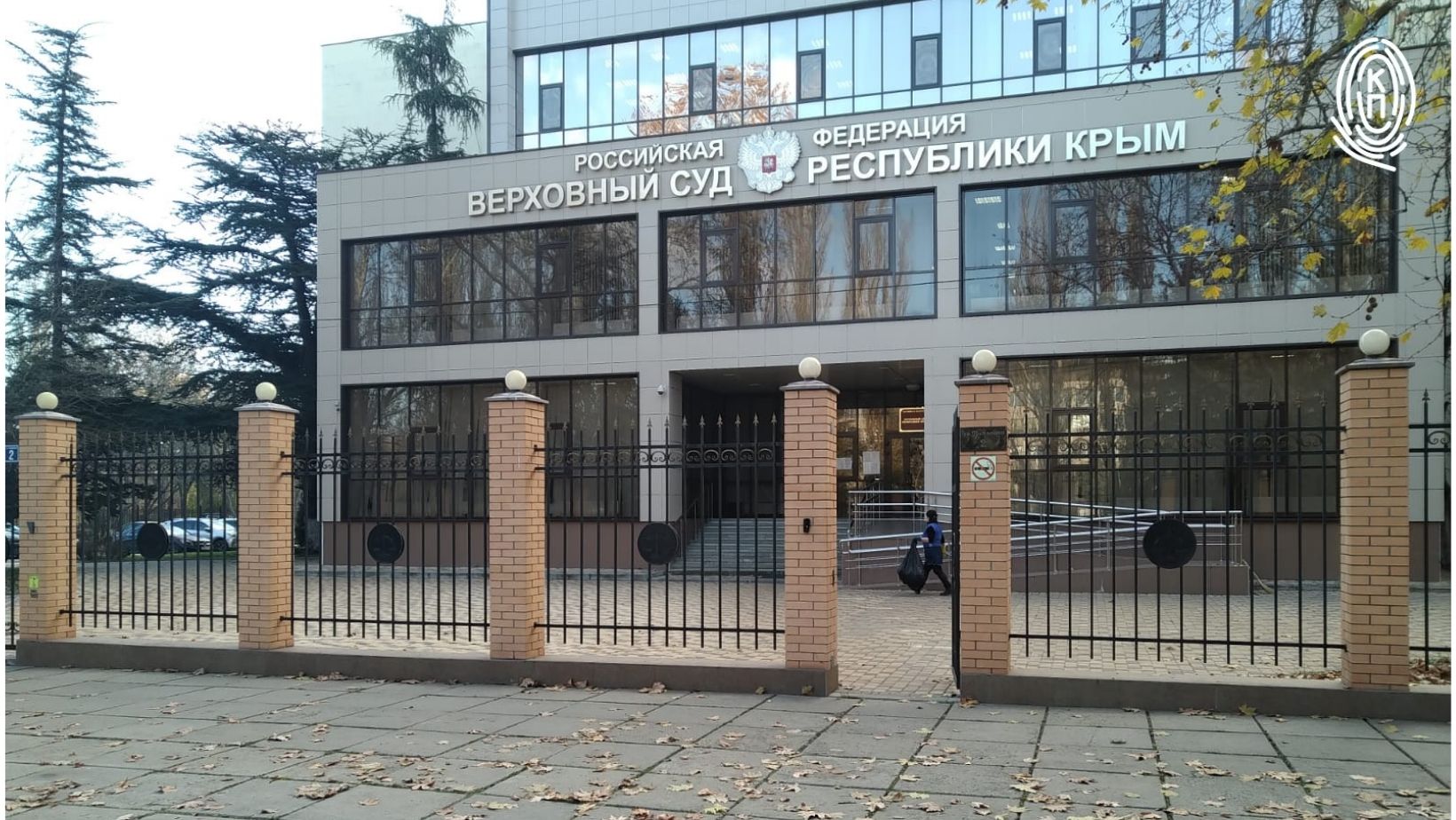
The Supreme Court of the Republic of Crimea has concluded its hearing of the criminal case against two unidentified residents of Crimea, who were found guilty of high treason and the unlawful possession of explosive devices. According to a statement from the Russian Prosecutor’s Office in Crimea, one of the defendants was sentenced to 21 years’ imprisonment, a fine of 300,000 roubles and a restriction of liberty for 1 year and 10 months following the completion of the main sentence, whilst the second defendant was sentenced to 22 years’ imprisonment, a fine of 500,000 roubles and restricted freedom for 1 year and 10 months.
According to the report, the convicted Crimeans “were opponents of the special military operation” and allegedly exchanged messages on a social media platform with a representative of Ukraine’s Main Intelligence Directorate. ‘Having received instructions from their handler, they retrieved a homemade explosive device based on hexogen from hiding places in the suburbs of Simferopol,’ reported the prosecution’s press office.
The personal details of the convicted Crimeans have been redacted on the court’s official website. All six court hearings and the pronouncement of the sentence took place behind closed doors. However, at the time of publication, there was no information to indicate that the sentencing had taken place, nor was the text of the court’s decision available. Taken together, this had a significant negative impact on the transparency and public nature of the trial. This was particularly true regarding the pronouncement of the sentence, which, according to existing standards, is always carried out in public.
Furthermore, the independence and impartiality of the presiding judge in the trial raise legitimate doubts, as the verdict was handed down by Judge Sergei Pogrebnyak, who is himself a defendant in a criminal case in Ukraine on charges of high treason. In view of this circumstance, he cannot be regarded as impartial and objective. This is all the more true in cases where Crimean residents are accused of collaborating with Ukrainian security forces. It is important to note that Pogrebnyak is one of the judges in the Supreme Court of Crimea most actively involved in hearing cases involving charges of high treason (this is his fifth verdict under this article since the start of 2026).
Furthermore, Sergei Pogrebnyak has already been implicated in other politically motivated prosecutions, notably in the trial of former police officer Lyudmila Kolesnikova and the Mariupol border guards, whom he convicted under criminal provisions of the Russian Criminal Code for actions they carried out as Ukrainian military personnel. The judge systematically ignored their status as prisoners of war.
An equally important aspect of the prosecution is the information campaign in the Crimean and major Russian media. There is a high degree of coordination between the court, the prosecution and the dissemination of information – formally, the sentencing was scheduled for 15:00, yet by 15:52 a prepared article accompanied by a photograph had already been published on the websites of the so-called Prosecutor’s Office of the Republic of Crimea. Overall, the campaign exhibited signs of a one-sided presentation of the verdict from the prosecution’s perspective. At least ten articles were identified on major federal news sites, the content of which reflected only the prosecution’s position, whilst the defence’s and the defendant’s positions were not represented in such articles.
Particular attention should be paid to the phrase ‘as opponents of the special military operation’, which may serve as an indicator of persecution for one’s political stance rather than for actual acts, the veracity of which raises insurmountable doubts. The joint study ‘Denial of the Right to a Fair Trial as an International Crime during Russia’s War against Ukraine: Context, Practice, Law and Prospects’ describes in detail how the Russian judicial system ignores the fact of an international armed conflict and Ukraine’s legitimate right to self-defence against military aggression by the Russian army.